
ProtiumTech's Latest Breakthrough: Improved Efficiency and Hydrogen Production Volume
ProtiumTech is proud to introduce a groundbreaking advancement in our membrane-free decoupled water acid electrolyzers. Through a specialized electrode preparation technique, we have achieved remarkable gains in both energy efficiency and production capacity, solidifying our position as the top solution in the market for efficient, cost-effective hydrogen production.
By using a modified electrode preparation technique and specially processed nanopowder of the active substance, we have significantly increased the capacity of the auxiliary electrode. This approach has also allowed us to reduce the working voltage in both the oxygen and hydrogen cycles. Additionally, by applying external incentives, we’ve achieved a drastic boost in efficiency.
“These advancements mark a major milestone for us,” says Mārtiņš Vanags, CTO of ProtiumTech. “Through precise modifications in electrode design and the use of specially processed materials, we’ve pushed the efficiency of our system beyond conventional limits. This is a breakthrough that directly enhances performance, allowing us to deliver a much more effective hydrogen production solution. We’re proud to see our technology reach this level of innovation.”
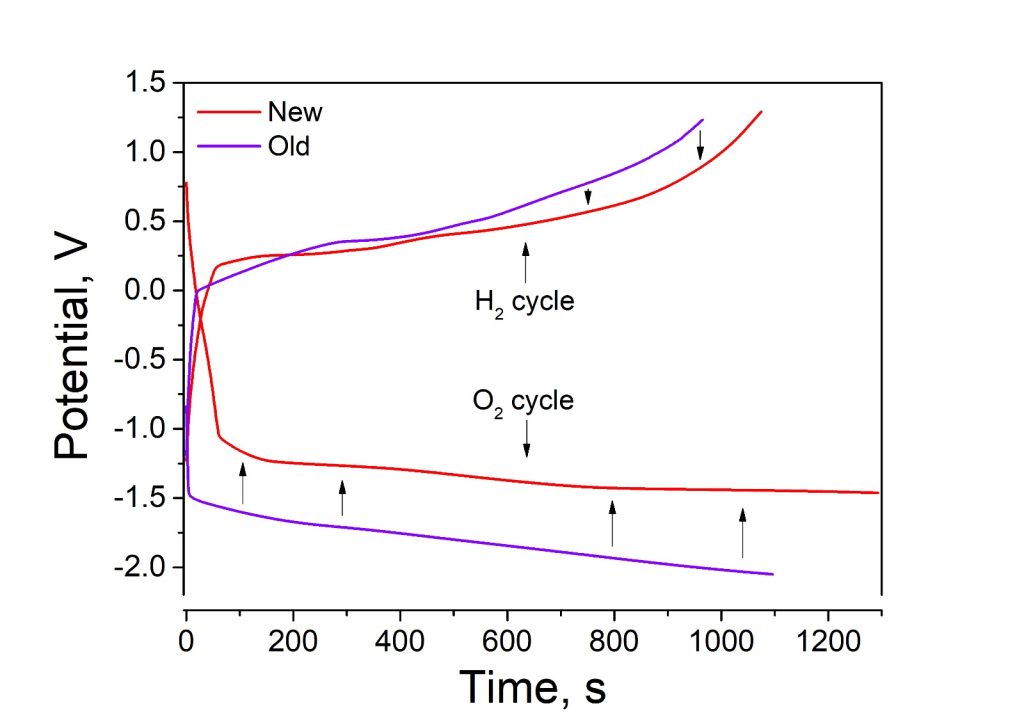
The figure below illustrates the performance differences between the current hydrogen production cycles (in purple) and the improved cycles (in red). As shown, the efficiency of the intercalation cycle (O2 cycle) has been significantly enhanced, resulting in substantial advantages.
HIGHER EFFICIENCY
Efficiency of the O2 cycle has been increased from 75.4% to 110%, as well as the overall efficiency to 71%.
MORE PRODUCED H2/DAILY
Higher O2 cycle efficiency results in a 46% increase in daily hydrogen production amount.
What are the benefits and how does it compare?
ProtiumTech electrolyzers stand apart from most on the market by utilizing an innovative two-step process for hydrogen production. In the first step, oxygen is generated (intercalation) without releasing hydrogen, while in the second step, pure hydrogen is produced (deintercalation).
To optimize performance over a 24-hour cycle, our system is designed to run 12 intercalation cycles and 12 deintercalation cycles. These cycles are flexible, allowing intercalation to take place during periods of available renewable energy and low electricity prices. Deintercalation cycle operates with an exceptional 311% efficiency, reducing electricity consumption by three times. This “energy management” ensures that our electrolyzer can operate continuously, achieving its full potential throughout the day and reducing the hydrogen production costs.
As shown in the image below, intercalation runs from midnight to 6:00 AM, when electricity is cheapest on the Nordpool market, and from noon to 6:00 PM, when renewable sources are most accessible. Deintercalation is scheduled during peak electricity hours, maximizing the advantages of both processes.
With increased intercalation efficiency to 110%, more hydrogen ions are stored in the auxiliary electrode, resulting in a 46% increase in daily hydrogen production. The highly efficient deintercalation cycle, which consumes three times less energy, when producing pure hydrogen, reduces the hydrogen production costs by 65%. This cost-effectiveness makes ProtiumTech’s green hydrogen a competitive alternative to gray hydrogen and by far the best solution in the market. “Our new electrolyzer technology achieves a level of efficiency that sets a new benchmark in the industry,” says Alens Martīni, CEO of ProtiumTech. “We’re very pleased with this accomplishment, as it allows us to push the boundaries of what’s possible in hydrogen technologies.”
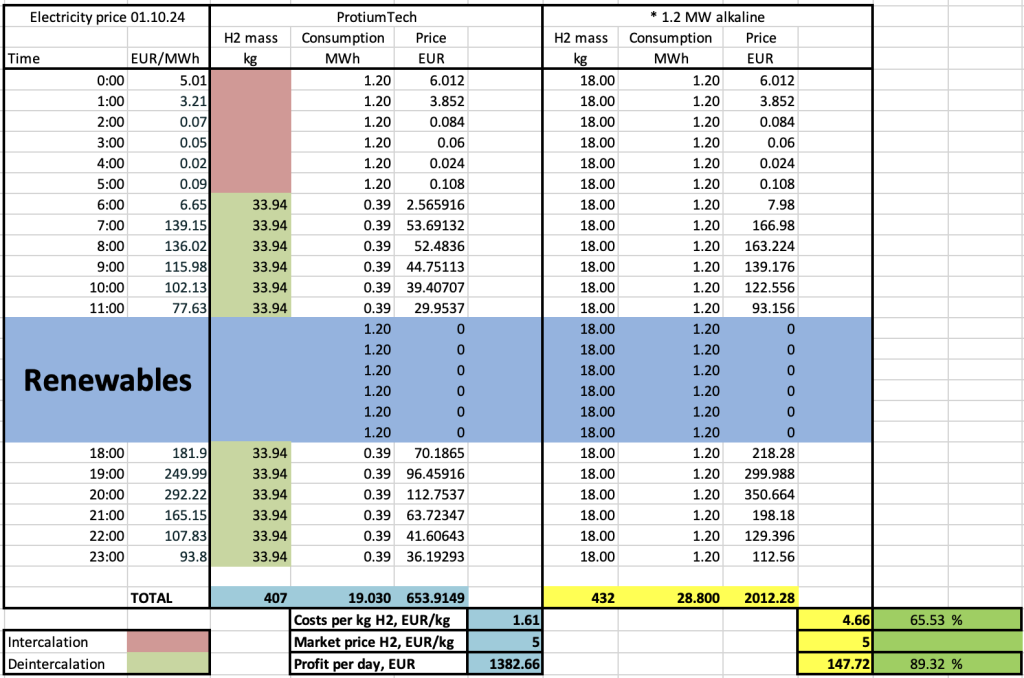
When comparing the performance of our electrolyzers to traditional alkaline electrolyzers, the difference is striking. For instance, on October 1st, 2024 (with 6 hours of renewables), our system produces hydrogen at a cost of just €1.61 per kilogram, which is 65.53% cheaper than the traditional alternative. Additionally, with a 1.2 MW electrolysis system, we produce 407 kg of hydrogen per day. Unlike traditional electrolyzers, ours doesn’t need to be shut down during high energy price periods, ensuring a consistent daily output. In contrast, traditional systems often fail to reach promised volumes due to the high cost of energy, therefore they have to shut down the operations.
